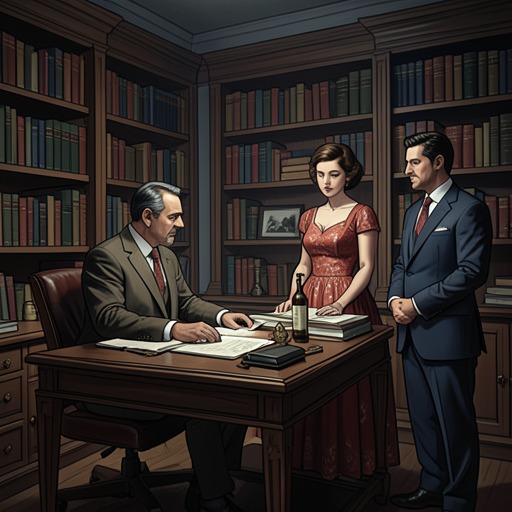
Wedding of Edward Derby and Asenath Waite
The Thing on the DoorstepThe wedding of Edward Pickman Derby and Asenath Waite, held about a month after Edward announced his intention to marry her, bound his lifelong dependence on others to a relationship that soon became entangled with Asenath’s occult studies and claims of bodily exchange. Recalled by Daniel Upton, the ceremony marks both a change in Edward’s apparent maturity and the beginning of the domestic setting from which their conflict would unfold.
Courtship and Decision
Edward met Asenath at a gathering in a student’s room, where her learning and appearance immediately captivated him. In the weeks that followed, he spoke to Daniel Upton almost entirely about her. When Edward brought Asenath to visit, Upton saw that her interest was equally strong and considered their intimacy already beyond easy separation.
Edward intended to marry Asenath and had begun looking at houses in the suburbs. His father, Mr. Derby, learned the truth from him and asked Upton, who usually had considerable influence over Edward, whether he could help end the match. Upton doubted that intervention would work: Edward’s dependence, he thought, had shifted from the parental figure to a new and more forceful one. Mr. Derby therefore offered no opposition after Upton advised him not to resist.
Ceremony and Settlement
The couple married a month later in a brief ceremony performed by a justice of the peace, as Asenath had requested. Mr. Derby, Upton, Upton’s wife, and their son attended, along with a group of young people from the college. The account presents the wedding as a modest civil occasion rather than a family celebration on a larger scale; its importance lies less in ceremony than in the life the couple arranged immediately afterward.
Asenath had bought the old Crowninshield House at the end of High Street in Arkham. After a short trip to Innsmouth, the couple intended to settle there, bringing back three servants, books, and household goods. Upton considered Asenath’s choice of Arkham significant: rather than return permanently to her former home, she seemed to prefer proximity to the college, its library, and the company of its self-described sophisticates.
Early Marriage
When Edward visited Upton after the honeymoon, he appeared changed. Asenath had persuaded him to shave his undeveloped moustache, but Upton noticed a broader shift: Edward seemed more sober and thoughtful, and the childish rebelliousness in his expression had given way to an almost genuine sadness. For a time, Upton wondered whether marriage might lead Edward toward adult responsibility and independence. The possibility remained uncertain; what looked like maturation could also be another change in whom Edward relied upon.
Asenath was occupied with restoring the house and grounds and had brought a large collection of books and apparatus from Innsmouth. Edward told Upton that, under her guidance, he was advancing in esoteric knowledge and that she proposed experiments he did not feel free to describe. He said he trusted her abilities and intentions. The household also included three unusual servants: an elderly couple who had served Asenath’s father, Ephraim Waite, and a younger woman. Their presence, and the unexplained references to Ephraim and Asenath’s deceased mother, gave the new household a history that Edward did not understand.
Conflict and Retrospective Significance
Years later, Edward’s account to Upton recast the marriage as the setting for a struggle over bodily control. He said Asenath had forced him to experience a distant ritual scene, and that she intended a ceremony at Hallowmass to make their exchange permanent. These claims reach the reader through Edward’s distressed testimony rather than Upton’s direct observation, but they transform the wedding’s apparent promise of a new adult life into the beginning of a contest Edward believed could cost him his identity.
In a later letter, Edward said he had killed Asenath because he believed she would otherwise take his body permanently. He then reported that, even after her death, her soul—or what he suspected was Ephraim Waite’s—continued to pursue a bodily exchange. The wedding thus stands at the start of a chain of events in which domestic intimacy becomes inseparable from Edward’s fear of possession. Upton’s early hope that marriage might foster independence is sharply contradicted by the outcome: Edward’s dependence does not end but becomes the ground on which the couple’s conflict takes hold.